Proprietorship Firm Registration In India
Want to start your business quickly with minimal compliances? A Proprietorship Firm is the perfect choice! We make Proprietorship Firm Registration in India easy, helping you register a proprietorship firm online with a hassle-free process. Let us take care of the registration of your Sole Proprietorship Firm, so you can focus on growing your business!
10,000+ businesses incorporated since 2002
Rated 4.9 stars by over 10K customers like you
Get Free Consultation by Expert
Proprietorship Firm Registration in India
A Proprietorship Firm, commonly referred to as a Sole Proprietorship, is one of the easiest and most widely used forms of business ownership in India. It is an unregistered and unincorporated business structure owned and managed by a single individual. Since there is no legal separation between the owner and the business, this model is highly preferred by freelancers, consultants, traders, and small business owners due to its low cost, minimal compliance, and quick setup.
The key feature of a proprietorship firm is single ownership, where the proprietor enjoys complete control over business operations and decision-making. All profits earned belong entirely to the owner, but at the same time, all losses and liabilities are also borne personally. Proprietorship firms are easy to start and close, as they involve very few legal formalities compared to companies or LLPs. However, since a proprietorship does not have a separate legal identity, the business cannot exist independently of its owner. This means contracts, assets, and legal obligations are directly linked to the proprietor. Opting for Sole Proprietorship Registration in India allows individuals to legally operate their business, open a bank account, and obtain necessary registrations such as GST or MSME. Many entrepreneurs now prefer sole proprietorship online registration for faster and more convenient setup.
A proprietorship firm is best suited for individuals who want full ownership, operational flexibility, and minimal regulatory burden. However, factors such as unlimited personal liability, limited funding options, and scalability challenges should be carefully evaluated. This structure is ideal for small-scale businesses or individuals who are starting their entrepreneurial journey and are comfortable managing business risks personally. Knowing the correct procedure for registering a Sole Proprietorship in India helps ensure a smooth and compliant business launch.
At Taxvarsha, we provide complete assistance for Proprietorship Firm Registration in India, handling all documentation and government formalities with precision and speed. Our expert team ensures a hassle-free online registration of sole proprietorship, helping you obtain all required registrations efficiently. If you’re planning to register your proprietorship firm, connect with Taxvarsha today for reliable, fast, and professional support.
Process of Proprietorship Firm Registration in India
Step 1: Select a Business Name
The first step in proprietorship firm registration is choosing a unique business name.
Ensure that:
The name is not already in use by another business
It does not violate any registered trademark
It complies with local and state regulations
A unique name helps in branding and avoids future legal issues.
Step 2: Obtain PAN Card of the Proprietor
Since a proprietorship firm does not have a separate legal identity, the proprietor’s personal PAN card is used for all business-related tax and financial transactions.
If you do not have a PAN, it must be applied for before proceeding further.
Step 3: Open a Current Bank Account
Open a current bank account in the name of the proprietorship firm.
Banks usually ask for:
PAN card of the proprietor
Business registration proof (GST, Shop & Establishment, or MSME certificate)
Address proof
A separate business bank account ensures proper financial management.
Step 4: Register Under the Shop and Establishment Act
If your business operates from a physical location, registration under the Shop and Establishment Act is mandatory.
This registration governs:
Working conditions
Employee rights
Business operating hours
The registration process and rules differ from state to state.
Step 5: Apply for GST Registration
GST registration is required if:
Annual turnover exceeds the prescribed limit
The business is involved in inter-state supply of goods or services
GST registration is completed online through the government GST portal and requires submission of relevant documents.
Step 6: Obtain Additional Business Licenses (If Applicable)
Based on the nature of your business, additional registrations may be required:
FSSAI License – for food-related businesses
IEC Code – for import and export businesses
Professional Tax Registration – applicable in certain states
MSME / Udyam Registration – optional but beneficial for government schemes and loans
Step 7: Local Authority Compliance
Depending on your business location, you may need approvals from local authorities such as:
Municipal Corporation
Panchayat
Local Trade License Department
These requirements vary based on the type and place of business.
Step 8: Maintain Proper Financial Records
Although formal audits are not mandatory for proprietorship firms, maintaining:
Income and expense records
Invoices and bills
Bank statements
is essential for taxation and smooth business operations.
Step 9: Tax Registrations and Regular Filings
The proprietor is personally responsible for:
Filing Income Tax Returns
Filing GST returns (if registered)
Complying with other applicable tax laws
Timely compliance helps avoid penalties and legal issues.
Step 10: Hire a Professional (Optional but Recommended)
Hiring an accountant or legal consultant can help in:
Smooth registration
Tax planning and filings
Ensuring legal and regulatory compliance
Professional guidance saves time and reduces compliance risks.
Conclusion
The Proprietorship Firm Registration Process in India is straightforward and ideal for individuals starting a small business. With proper registrations, licenses, and compliance, a sole proprietorship can operate smoothly and grow sustainably.
Documents Required for Proprietorship Firm Registration
To complete the Proprietorship Firm Registration in India smoothly, the following documents are required from the proprietor. Ensuring correct documentation helps avoid delays and ensures hassle-free registration.
Identity Proof of Proprietor
A valid PAN Card of the proprietor is mandatory for proprietorship registration, as it serves as the primary tax identity.
PAN & Aadhaar Details
Self-attested copies of both PAN Card and Aadhaar Card of the proprietor are required for identity verification and government records.
Business Address Proof
Proof of the registered business address is essential. This can include:
Latest Utility Bill (Electricity, Water, Gas, or Telephone), or
Property Tax Receipt
If the premises are rented, a Rent Agreement along with a No Objection Certificate (NOC) from the property owner must be submitted.
Additional Identity Proof
Any one of the following documents of the proprietor may be required:
Aadhaar Card
Passport
Voter ID
Driving License
Contact Details
A valid email ID and mobile number of the proprietor are required for registration, verification, and official communication.
Photographs
Recent passport-size photographs of the proprietor are required for records and application purposes.
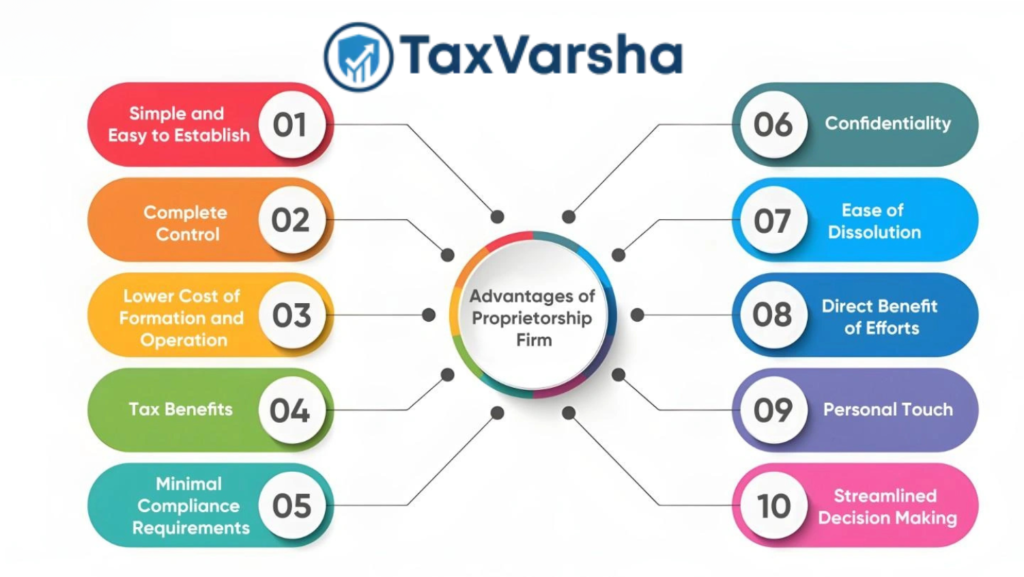
Advantages of Proprietorship Firm Registration
How Taxvarsha team will help in the Proprietorship Firm Registration Process?
We believe in complete handholding of our clients. We will assign a personal manager to assist you with the entire process of Proprietorship Firm Registration in India. Our team will guide you through each step and ensure that all necessary registrations for your proprietorship firm are completed in a reasonable time, subject to the provision of required documents and information by the client.
FAQs
What is a Proprietorship Firm?
A Proprietorship Firm is the simplest form of business structure in India, owned and managed by a single individual. The proprietor and the business are considered the same legal entity, meaning all profits and liabilities belong solely to the owner.
How is a Proprietorship Firm registered in India?
There is no separate legal registration for a proprietorship firm in India. It is established by obtaining basic registrations such as PAN, GST (if applicable), Shop & Establishment License, and a current bank account in the business name.
What are the key advantages of a Proprietorship Firm?
Some major benefits include:
Easy and low-cost setup
Minimal compliance requirements
Complete control over business decisions
Quick operational start
Ideal for small businesses and freelancers
Are there any disadvantages to a Proprietorship Firm?
Yes, a few limitations include:
Unlimited personal liability
Limited ability to raise funds
No separate legal identity
Business continuity depends on the proprietor
How is a Proprietorship Firm taxed in India?
A proprietorship firm is taxed as an individual. The income earned from the business is added to the proprietor’s personal income and taxed according to the individual income tax slab rates.
Is it mandatory to have a separate bank account for a Proprietorship Firm?
While not legally mandatory, having a separate current bank account in the firm’s name is highly recommended to maintain financial transparency and credibility.
Can a Proprietorship Firm be transferred to another person?
No, a proprietorship firm cannot be transferred as it is inseparable from the owner. However, the business assets can be sold, or the business can be converted into another structure like a partnership or company.