Conversion of LLP to Private Ltd. Company
Effortlessly convert your LLP into a Private Limited Company with the Taxvarsha team’s assistance, ensuring a streamlined and professional transition process.
10,000+ businesses incorporated since 2002

Get Free Consultation by Expert
Conversion of LLP to Private Limited Company in India
The conversion of a Limited Liability Partnership (LLP) into a Private Limited Company is a strategic move for businesses aiming to scale operations, raise equity funding, and adopt a more structured corporate framework. This conversion was formally enabled by the Ministry of Corporate Affairs (MCA) through a notification issued on 31 May 2016, allowing LLPs to transform into companies under specified conditions.
The conversion process is governed by the Companies Act, 2013 and requires careful adherence to prescribed legal procedures. It involves preparing and filing a set of statutory forms with the Registrar of Companies (ROC), such as URC-1 for conversion, along with incorporation-related forms including INC-32 (SPICe+), INC-33 (MOA), and INC-34 (AOA). Each form must be supported by accurate documentation to ensure smooth approval.
Apart from corporate law compliance, businesses must also evaluate the income tax implications of conversion. Particular attention should be given to capital gains tax, as the transfer of assets and liabilities from the LLP to the private limited company may attract tax unless specific exemption conditions are fulfilled under the Income Tax Act.
This article focuses on explaining the legal provisions under the Companies Act, the step-by-step conversion mechanism, and the capital gains considerations involved in converting an LLP into a private limited company. A thorough understanding of these aspects helps businesses make an informed decision and ensures a compliant and tax-efficient transition.
Process for Converting LLP to Private Limited Company in India
1. Obtain Digital Signature Certificates (DSC)
The initial step is to secure Digital Signature Certificates for all proposed directors and shareholders. DSCs are mandatory for electronically signing and submitting incorporation and conversion forms on the MCA portal.
2. Apply for Director Identification Number (DIN)
Each individual appointed as a director in the proposed private limited company must possess a valid Director Identification Number (DIN). DIN can be applied for online during the incorporation process if not already allotted.
3. Reserve the Company Name
A distinct and compliant name must be selected for the private limited company. Name availability is checked and reserved through the MCA name approval system, ensuring the name does not conflict with existing companies or trademarks.
4. Draft and Submit Conversion Documents
Key constitutional documents are prepared, including:
Memorandum of Association (MOA) defining business objectives
Articles of Association (AOA) outlining internal governance rules
Along with these, conversion-related forms such as URC-1 and incorporation forms are filed online with the Registrar of Companies (ROC) via the MCA portal for review and approval.
5. Payment of Statutory Fees
Government filing fees and applicable stamp duty must be paid based on the authorized share capital and state-specific regulations.
6. Verification and Approval by ROC
The ROC examines the submitted forms and documents. Upon satisfactory verification, a Certificate of Incorporation is issued, officially confirming the conversion of the LLP into a private limited company.
7. PAN and TAN Registration
After incorporation, the newly established private limited company must apply for its Permanent Account Number (PAN) and Tax Deduction and Collection Account Number (TAN) for taxation and statutory compliance.
8. Updating Business Registrations and Licenses
All existing registrations and operational licenses must be updated to reflect the new company structure. This includes:
GST registration
Bank accounts
Industry-specific approvals and permits
Converting an LLP into a private limited company enables better access to capital, improved governance, and enhanced business credibility when executed in compliance with regulatory requirements.
Documents Required for Conversion of LLP into Private Limited Company
Application for Conversion
A formal application for converting the LLP into a private limited company.
Memorandum of Association (MOA)
This document defines the company’s main objectives and powers.
Articles of Association (AOA)
This document outlines the company’s internal rules, regulations, and governance structure.
Declaration of Compliance
A declaration by the proposed directors confirming compliance with all legal requirements.
LLP Agreement
The original LLP agreement that outlines the terms and conditions of the existing LLP.
Financial Statements
Copies of audited financial statements of the LLP for the previous years.
Proof of Address
Address proof for the registered office of the company.
Identity and Address Proof
Identity and address proof of all directors and shareholders.
NOC from Partners
A No Objection Certificate (NOC) from all partners of the existing LLP, stating their consent for conversion.
Digital Signature Certificates (DSC)
DSCs for all directors and shareholders.
Director Identification Number (DIN)
DIN for all directors.
Name Availability Certificate
A certificate confirming the availability of the chosen company name.
Consent Letter
A letter of consent from all partners to become shareholders in the newly formed private limited company.
Minutes of Meeting
Minutes of the meeting where the partners decided to convert the LLP into a private limited company.
Key Documents Required for LLP to Private Limited Company Conversion
1. Application for Conversion
A duly filled and signed application requesting approval for conversion of the LLP into a Private Limited Company.
2. Memorandum of Association (MOA)
The MOA defines the company’s core objectives, scope of operations, and authorized activities after conversion.
3. Articles of Association (AOA)
The AOA lays down the internal rules, governance structure, and operational framework of the new private limited company.
4. Declaration of Compliance
A statutory declaration from the proposed directors confirming that all provisions of the Companies Act, 2013 have been complied with.
5. LLP Agreement
A copy of the existing LLP Agreement detailing the rights, duties, and profit-sharing arrangement of partners.
6. Financial Statements of LLP
Audited financial statements of the LLP for previous financial years, including:
Balance Sheet
Profit & Loss Account
Auditor’s Report
7. Proof of Registered Office Address
Valid address proof of the company’s registered office, such as:
Electricity bill / Utility bill
Rent agreement (if rented)
Ownership proof (if owned)
8. Identity and Address Proof of Directors & Shareholders
Self-attested copies of:
PAN Card
Aadhaar Card / Passport / Voter ID
Latest address proof
9. No Objection Certificate (NOC) from LLP Partners
A written consent from all existing LLP partners, approving the conversion into a private limited company.
10. Digital Signature Certificate (DSC)
Valid DSCs of all proposed directors and shareholders for online filing of forms with MCA.
11. Director Identification Number (DIN)
DIN is mandatory for all directors of the new private limited company.
12. Name Availability Certificate
Certificate confirming that the proposed company name is available and approved by the MCA.
13. Consent Letter from Partners
A formal consent stating that existing LLP partners agree to become shareholders of the private limited company.
14. Minutes of Meeting
Certified minutes of the LLP partners’ meeting where the decision for conversion was passed.
Documents to be Uploaded Along with Form URC-11
The following documents must be attached while filing Form URC-11 with the Registrar of Companies:
List of Members with details such as:
Name
Address
Shareholding pattern
List of First Directors including:
Name
Address
DIN
Passport (if applicable)
Complete list of LLP partners with personal details
Certified copy of:
LLP Registration Certificate
LLP Agreement (verified by at least two partners)
Statement of Nominal Share Capital specifying:
Authorized capital
Number of shares
Face value per share
Shareholding distribution
No Objection Certificate from all creditors of the LLP
Auditor-certified statement of accounts:
Not older than six days from application date
Copy of newspaper advertisement (if applicable)
Detailed statement showing:
Total number of shares
Share division ratio
Shares subscribed and amount paid
Existing LLP name with the addition of “Private Limited”
Conclusion
The conversion of an LLP into a Private Limited Company requires accurate documentation, statutory approvals, and professional compliance. Any error or missing document can delay the registration process. Hence, proper planning and expert guidance are essential to ensure a smooth and hassle-free conversion.
Advantages of Converting LLP to Private Limited Company
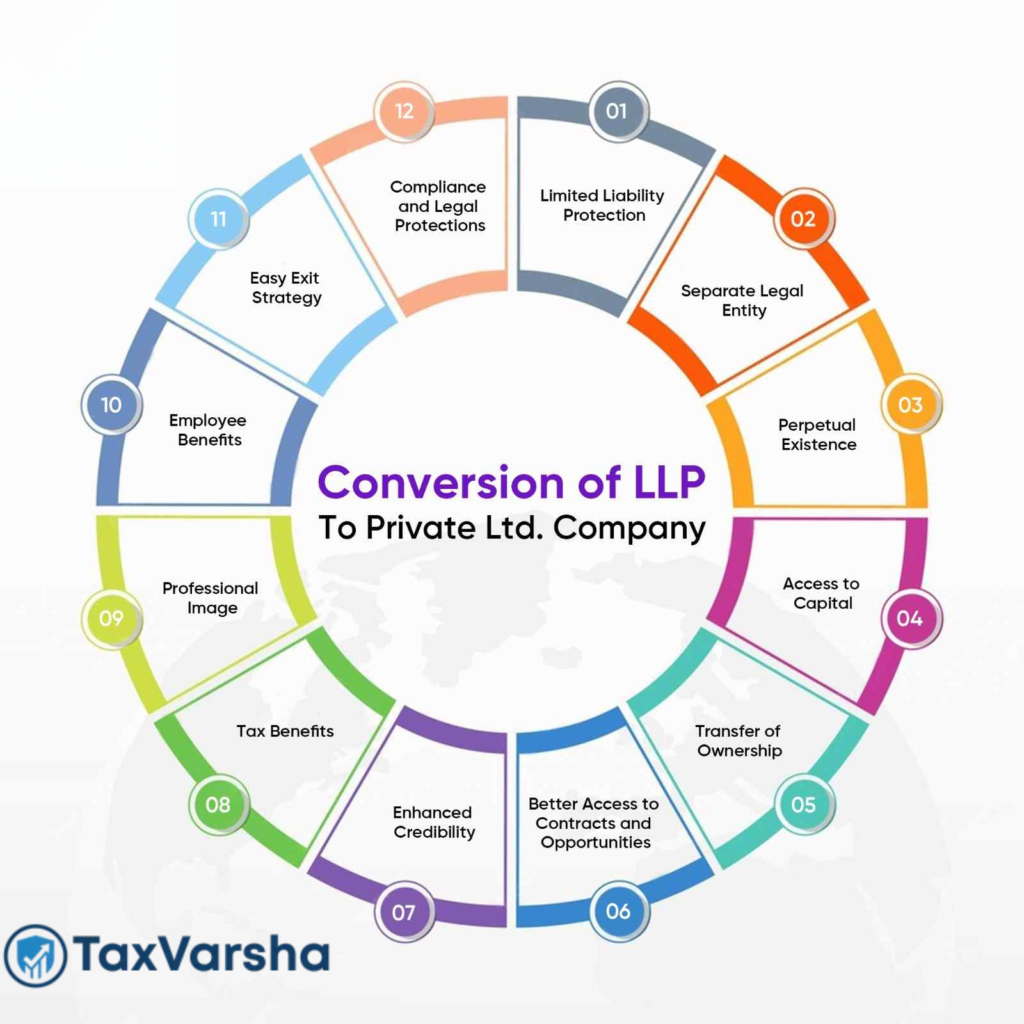
FAQs
Why should an LLP be converted into a Private Limited Company?
Many businesses convert an LLP into a Private Limited Company to gain better credibility, scalability, and funding opportunities. Private Limited Companies are preferred by investors, banks, and venture capitalists due to their structured ownership, shareholding flexibility, and stronger compliance framework. Conversion also helps in expanding operations and building long-term brand value
What are the eligibility criteria for converting an LLP into a Private Limited Company?
Yes, conversion of an LLP into a Private Limited Company is legally permitted in India under the Companies Act, 2013, subject to fulfillment of prescribed conditions and approval from the Registrar of Companies (ROC).
Is conversion from LLP to Private Limited Company allowed under Indian law?
To be eligible for conversion:
All partners of the LLP must become shareholders of the company
There should be no secured creditors, or written consent must be obtained from them
The LLP must have complied with all statutory filings
Approval from partners and creditors is mandatory
What are the steps involved in the LLP to Private Limited conversion process?
The conversion process generally includes:
Obtaining DSC and DIN
Name approval from MCA
Drafting MOA and AOA
Filing Form URC-11 with ROC
Submission of required documents
ROC verification and issuance of Certificate of Incorporation
What documents are required for LLP to Private Limited Company conversion?
Key documents include:
LLP Agreement
MOA and AOA
Financial statements
Partner and director KYC documents
NOCs from partners and creditors
Form URC-11 attachments
Proof of registered office
Does conversion impact existing contracts or liabilities of the LLP?
No, conversion does not affect existing contracts, assets, or liabilities. All agreements, debts, obligations, and legal proceedings of the LLP automatically transfer to the Private Limited Company